
6. The Trading Halt Mechanism in the US Stock Market
Trading during extended hours opens up additional opportunities, but in the stock market prices can change rapidly at any moment. What happens when fluctuations become too strong? Today we will look at how the trading halt mechanism works in the American market.
The trading halt mechanism is an emergency regulatory measure that stops exchange trading for a certain period to prevent panic selling. Despite the fact that the US stock market has no daily price limits, halt mechanisms are triggered when an individual stock shows a sharp fluctuation in either direction, or when a market index experiences a crash.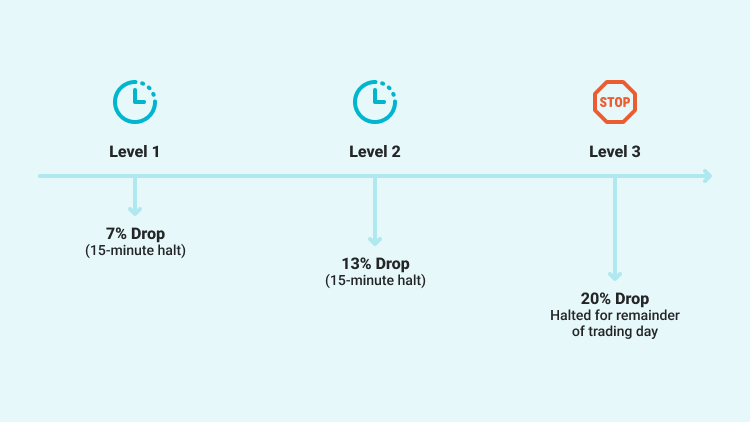
The thresholds for a market index decline are divided into three levels: 7%, 13%, and 20% from the previous day's closing price, respectively. As shown below: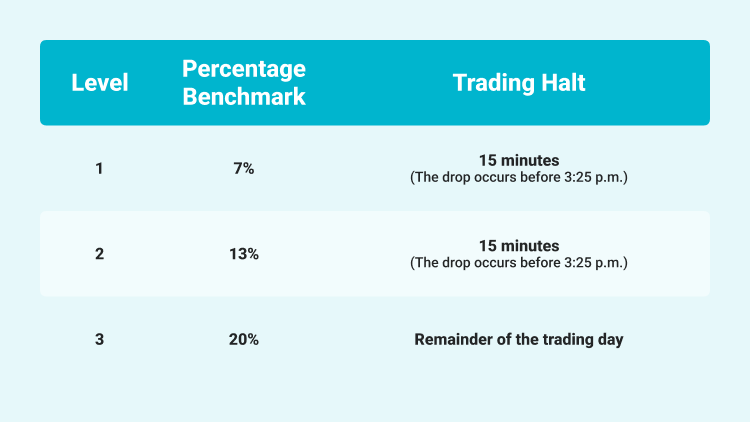
A market decline that triggers a Level 1 or Level 2 mechanism before 15:25 (before 0:25 Kazakhstan Time) will lead to a 15-minute trading halt, while a similar market decline at exactly 15:25 (at 0:25 Kazakhstan Time) or later will not lead to a general trading halt. A market decline that triggers a Level 3 mechanism at any time during the trading session will lead to a complete halt of trading across the entire market until the end of the trading day.
The first market-wide trading halt mechanism was introduced after "Black Monday" on October 19, 1987, when the Dow Jones Industrial Average fell by almost 23% in a single day. Recent triggers of the mechanisms occurred on March 9, 12, 16, and 18, 2020, in response to the severe consequences of the growing global coronavirus pandemic.
Trading halts help the market cope with sharp fluctuations and unusual situations. But who sets such rules and monitors compliance with them? In the next lesson, we will look at who regulates the US stock market.
*Disclaimer: The above content only represents the author's personal position and opinion and does not represent any position of tickrs and tickrs cannot confirm the authenticity, accuracy, and originality of the above content. Investors should consider the risks of investment products in light of their circumstances before making any investment decisions.